


Syllabus: GS3/ Science and Technology
Context
- India has achieved a major milestone as the indigenously built Prototype Fast Breeder Reactor (PFBR) at Kalpakkam has attained criticality.
Prototype Fast Breeder Reactor (PFBR)
- PFBR is an advanced reactor that generates more fissile fuel than it consumes.
- India’s PFBR is located at Kalpakkam and operated by Bharatiya Nabhikiya Vidyut Nigam Limited. It uses Uranium–Plutonium Mixed Oxide (MOX) fuel.
- It is called a fast breeder because;
- It uses high-energy, fast neutrons to sustain the fission reaction, rather than the slowed-down thermal neutrons used in standard reactors.
- It converts fertile material (like Uranium-238) into fissile material (Plutonium-239).
- The criticality refers to the point at which a reactor achieves a self-sustaining nuclear fission reaction, where the number of neutrons produced is sufficient to keep the reaction going without external intervention.
Significance of the Achievement
- Advancement of India’s Three-Stage Nuclear Programme: The PFBR marks progress in the second stage of India’s three-stage nuclear programme.
- It enables the conversion of fertile material into fissile fuel.
- It lays the foundation for the third stage, which focuses on thorium utilization.
- Harnessing Thorium Potential: India possesses vast thorium reserves, and the PFBR helps generate the required fissile material (U-233) for thorium-based reactors.
- Thorium-232, is not fissile but can be converted into a fissile material.
- Technological and Strategic Significance: India becomes only the second country after Russia to develop a commercial fast breeder reactor.
- It demonstrates advanced indigenous capability in nuclear technology and engineering.
India’s Three-stage nuclear programme
- Establishment: India established the Atomic Energy Commission in 1948.
- In 1956, Asia’s first research reactor, Apsara, was commissioned at the Bhabha Atomic Research Centre (BARC) in Trombay.
- India was the second Asian nation to build a nuclear power plant in 1969 at Tarapur, just after Japan and long before China.
- India has a three-phase programme of nuclear power visioned by Dr Homi J Bhabha, the father of India’s nuclear programme.
- First Stage (Pressurized Heavy Water Reactors – PHWRs): India’s nuclear program initially focused on establishing a fleet of PHWRs.
- These reactors use natural uranium (U-238), which contains minuscule amounts of U-235, as the fissile material.
- Heavy water (deuterium oxide) as both moderator and coolant.
- The primary purpose of this stage was to produce plutonium-239 as a byproduct from the uranium fuel.
- Plutonium-239 is a fissile material used as fuel in nuclear reactors.
- Second Stage (Fast Breeder Reactors – FBRs): The second stage of the program involves the deployment of Fast Breeder Reactors (FBRs).
- FBRs are designed to produce more fissile material than they consume by utilizing a fast neutron spectrum.
- In this stage, plutonium-239 produced in the first stage is used as fuel along with U-238 to produce energy, U-233, and more Pu-239.
- Uranium-233 is another fissile material that can be used as fuel in nuclear reactors.
- Third Stage (Advanced Heavy Water Reactors – AHWRs): The final stage of the program entails the deployment of Advanced Heavy Water Reactors (AHWRs).
- Pu-239 will be combined with thorium-232 (Th-232) in reactors to produce energy and U-233.
- Thorium is abundantly available in India, and this stage aims to harness its potential as a nuclear fuel.
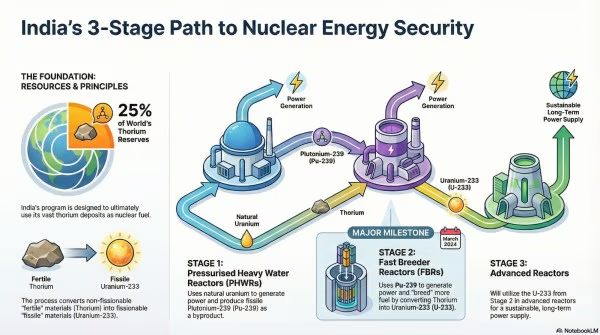
Source: PIB
Previous article
One Health Approach for an Interconnected World
Next article
Deep Tech in India
